










Armored cables and conventional cables do not have the same structure and, as a result, cannot always be processed in the same way. The presence of protective metal braid, wires, or tape makes the stripping process more demanding. For recycling and metal recovery companies, using a machine designed to handle this type of material makes it possible to separate the metal component from the jacket and send the different fractions for recovery.
What are armored cables and where are they used?
An armored cable is an electrical cable fitted with additional metal protection. This protection may consist, for example, of metal braid, steel wires, or metal tape.
The armor performs a protective function: it increases the cable's resistance to mechanical stress and allows it to be used in applications where greater protection is required.
Armored cables are used in a range of settings, including power installations, industrial applications, underground installations, and the marine sector. Once they reach the end of their service life, they represent an important source of recoverable materials.
Why armored cables are difficult to recycle with a standard cable stripper
The presence of the armor changes the cable's behavior during processing. A cable stripper designed primarily for standard cables only has to deal with a simpler structure, while an armored cable includes an additional metal component that must be managed during the cutting and stripping stages.
The challenge is not limited to the jacket. The operator has to process a multilayer material with metal protection that may consist of steel or other metals.
For this reason, when selecting an industrial cable stripping machine, it is important to verify in advance which materials and cable diameters are compatible with the machine.
The Black Box ST57100 is designed to process electrical cables, including armored cables. The cables must be prepared according to the machine's accepted input specifications.
For the Black Box ST57100, the input cable diameter ranges from approximately 0.79 to 4.33 inches (20 to 110 mm), making the machine suitable for handling cables with different diameters.
Armored cable stripper: why a dedicated machine is required
In armored cable recycling, the objective is not simply to cut the cable, but to achieve effective separation between the recoverable metal component and the jacket.
A machine specifically configured for this task can process the material while accounting for the presence of the armor, rather than treating it as an ordinary cable without metal protection.
This is particularly important for recycling companies, scrapyards, and facilities that receive mixed cable streams and need to manage materials with different characteristics.
How copper and steel are separated in an armored cable stripper
The principle is straightforward. The cable is fed into the machine, where the internal cutting and stripping unit processes its structure to separate the metal component from the outer jacket.
With the Black Box ST57100, the metal component may include copper, aluminum, and/or steel armor, while the jacket may be made from plastic or rubber-based materials.
The different components are separated so that they can then be sent to their respective recovery and recycling processes.
It is important to distinguish this process from any subsequent separation of different metals. The primary function of the Black Box ST57100 is to separate the metal component from the jacket. Any additional separation of copper, aluminum, and steel depends on the composition of the material and the facility configuration.
The value of recovery: separated copper, aluminum, and steel
The value of the recovery process comes from transforming a composite material into fractions that are easier to manage in subsequent recycling stages.
Recovering copper from armored cables makes it possible to add value to one of the main materials found in electrical cables, while the steel armor represents an additional recoverable metal fraction.
Separating the jacket also plays an important role. Plastic and rubber can be managed separately from the metal component, avoiding the need to treat the entire cable as a single material.
From an industrial perspective, effective separation facilitates the handling of the recovered fractions and allows each material to be directed to the appropriate recycling process.
Black Box ST57100: the Stokkermill solution for armored cables
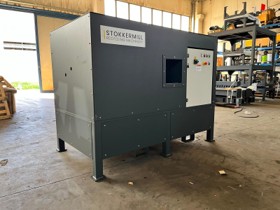
The Black Box ST57100 is the Stokkermill cable stripper developed by Seltek S.r.l. for processing electrical cables, including armored cables with metal braid, steel wires, or metal tape.
The machine incorporates an internal cutting and stripping unit designed to separate the metal component from the outer jacket. The material is loaded manually, and the processed product is collected in the machine's discharge area.
The Black Box ST57100 can process cables with diameters ranging from approximately 0.79 to 4.33 inches (20 to 110 mm), in accordance with the specifications defined for the machine.
For a company that regularly processes armored cables, selecting the right cable stripper should begin with an assessment of the material type, cable diameters, and condition of the cables to be processed.
Would you like to verify whether the Black Box ST57100 is suitable for your cables?
Every material may have different characteristics. Contact Stokkermill to request more information, arrange a material test, and identify the most suitable solution for your recovery process.
Discover the Black Box ST57100 →