






XRAY selector
1. General Description
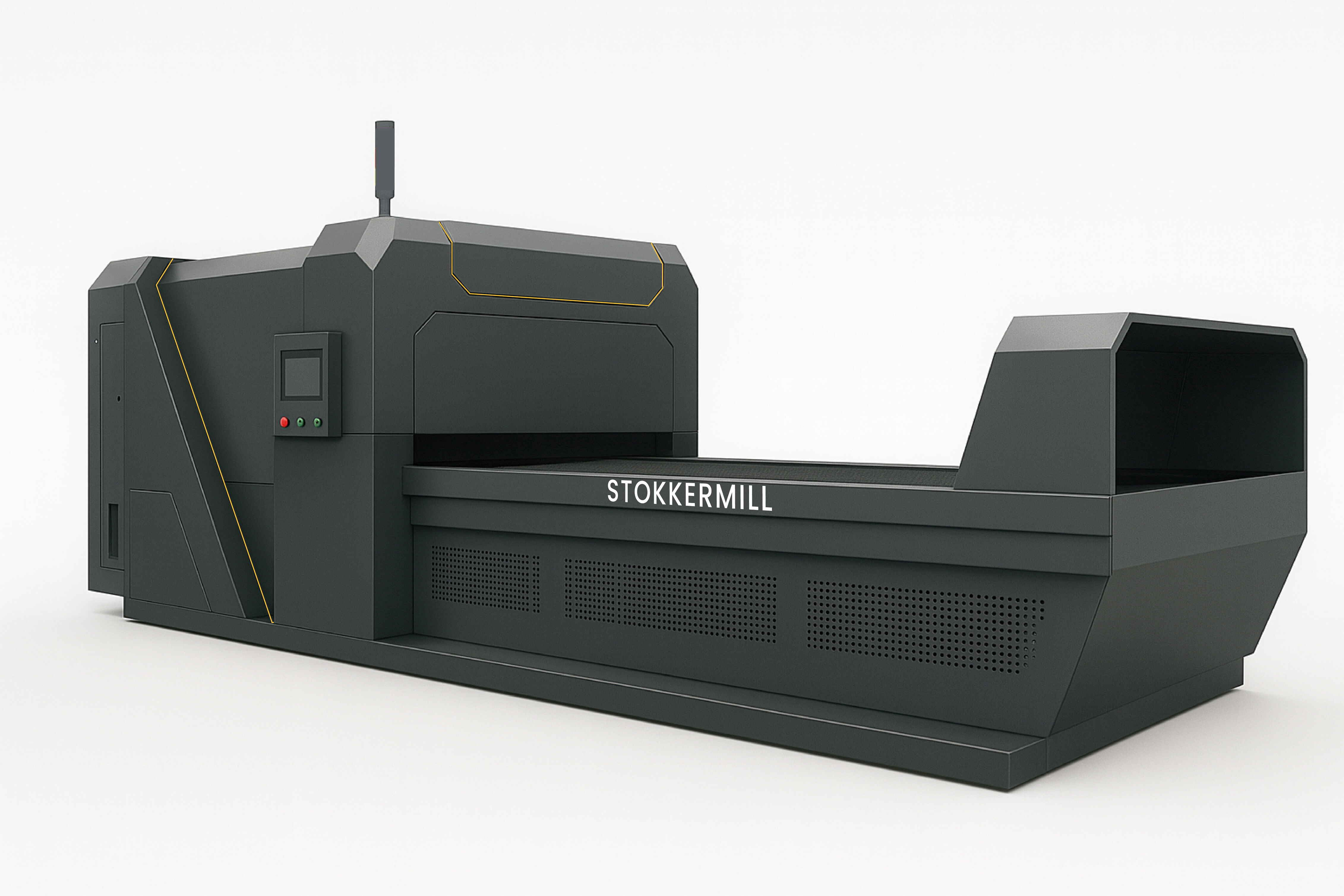
Maximum material-flow stability, maximum economic yield. The 47.2-inch dual-belt configuration of the Glass Series 1200 provides maximum material-flow stability by eliminating the rolling and bouncing commonly associated with single-belt systems.
Greater stability gives the system more effective scanning time for each fragment and improves ejection accuracy, helping produce a cleaner final fraction with greater market value.
Operating principle
Material is fed through a dual vibratory feeder and moves in a consistent flow past the optical scanning system. The cameras identify the color, shape, and material of each fragment in real time, distinguishing acceptable glass from contaminants such as ceramics, stone, porcelain, and metals. A compressed-air system ejects the identified contaminants with millimeter-level precision.
2. Technical Specifications
| Effective working width | 47.2 in (1,200 mm) |
|---|---|
| Configuration | Dual level / Dual belt (Double Layer) |
| Throughput | 13.2-22.0 U.S. short tons/hr (12.0-20.0 metric t/h) |
| Sorting accuracy / Purity | ≥ 96% on fractions with initial contamination < 2% |
| Installed electrical power | 3.0 hp (2.2 kW) |
| Electrical supply | 220 V / 50 Hz |
| Compressed-air pressure | 58-116 psi (0.4-0.8 MPa) |
| Compressed-air consumption | 88-155 CFM (2.5-4.4 m³/min) |
| Overall dimensions (L x W x H) | 128.7 x 91.2 x 75.9 in (3,270 x 2,316 x 1,927 mm) |
| Machine weight | 3,704 lb (1,680 kg) |
| Operating conditions | Suitable for dry and wet glass |
3. Key Strengths and Competitive Advantages
- Simultaneous three-parameter sorting: color, shape, and material recognition through Quantum Recognition in a single pass.
- Removal of critical contaminants: effective separation of ceramics, stone, porcelain (CSP), and metals.
- Self-learning AI: continuous adaptation to the incoming material mix without machine downtime.
- Industry 4.0 connectivity: ready for remote support, remote diagnostics, and cloud-based updates.
4. Applications
Stokkermill optical sorting solutions can be used across the primary industrial recycling sectors:
- Glass: color- and size-based sorting of clean material streams.
- Plastics: sensor-based polymer sorting for high-quality plastics recycling.
- Metals: high-precision sorting for sustainable metal recovery.
- Paper and cardboard: precision sorting for the recovery of high-quality paper.
- Electronic waste: in-line separation of electronic components.
- Biomass and organic material: optical sorting for clean biodegradable streams.
- Refuse-derived fuel: efficient sorting for sustainable refuse-derived fuel production.
- Wood: precision sorting for the recovery of recycled wood.
- Textiles: efficient fiber sorting for circular textile production.
5. Separation Matrix - Performance
| Input material | Sorting result | Purity rate |
|---|---|---|
| Mixed glass | Glass sorted by color | > 98% |
| Mixed plastics (PET / HDPE / PP) | Polymers sorted by type | ≥ 96% |
| Mixed scrap containing metals | Recovered and separated metals | ≥ 97% |
| Mixed paper and cardboard | Sorted cellulose fraction | ≥ 95% |
| Mixed WEEE / E-scrap | Isolated electronic components | ≥ 95% |
| Mixed organic fraction | Clean sorted biomass | ≥ 95% |
| Mixed non-recyclable waste | Quality SRF / RDF | ≥ 95% |
| Mixed recovered wood | Wood sorted for reuse | ≥ 96% |
| Mixed post-consumer textiles | Sorted textile fibers | ≥ 95% |
6. Technology and Process Integration
In addition to optical sorting, the Glass Series 1200 integrates features designed to simplify day-to-day operation and support plant maintenance, control, and optimization processes.
- Cyber-physical system: the physical machine is supported by a digital model that reproduces its behavior during production. This integration makes it possible to predict performance, identify potential issues in advance, and optimize operation using data collected under actual operating conditions.
- Remote maintenance, diagnostics, and control: technical support personnel can monitor machine status, identify the cause of an issue, and intervene remotely, reducing plant downtime and the need for on-site service visits.
- “Capture” function: after a material sample is fed through the infeed chute, the operator selects the acceptable material and the reject directly on the screen. The machine then acquires the parameters required to begin operation without complex manual calibration.
7. UHD AI Deep Learning 3.0
The artificial intelligence technology collects and processes large volumes of data to recognize patterns and generate increasingly accurate predictions. Deep Learning uses multilayer neural networks: as more data is analyzed, the system learns and continuously optimizes the sorting process.
- 01 - Data collection: after the initial sorting cycles, thousands of high-resolution images of foreign objects and defects are collected to build a database specifically tailored to the installation.
- 02 - Calibration: the Deep Learning platform automatically calibrates the machine using the collected images, without complex manual intervention.
- 03 - Solution generation: the system independently proposes and applies the most effective sorting solutions using the artificial intelligence integrated into the machine.
The technical and performance data shown are approximate values measured under standard operating conditions and may vary depending on the actual composition of the input material. The 220 V / 50 Hz electrical specification is reproduced from the source technical sheet; the electrical configuration for a U.S. installation must be confirmed in the applicable commercial quotation. Refer to that quotation for final contractual specifications.