


We develop the best technologies for recycling materials to find innovative solutions for the energy and ecological transition
STOKKERMILL | SELTEK SRL © 2023 | P. Iva. IT02360630301 | Privacy | Terms









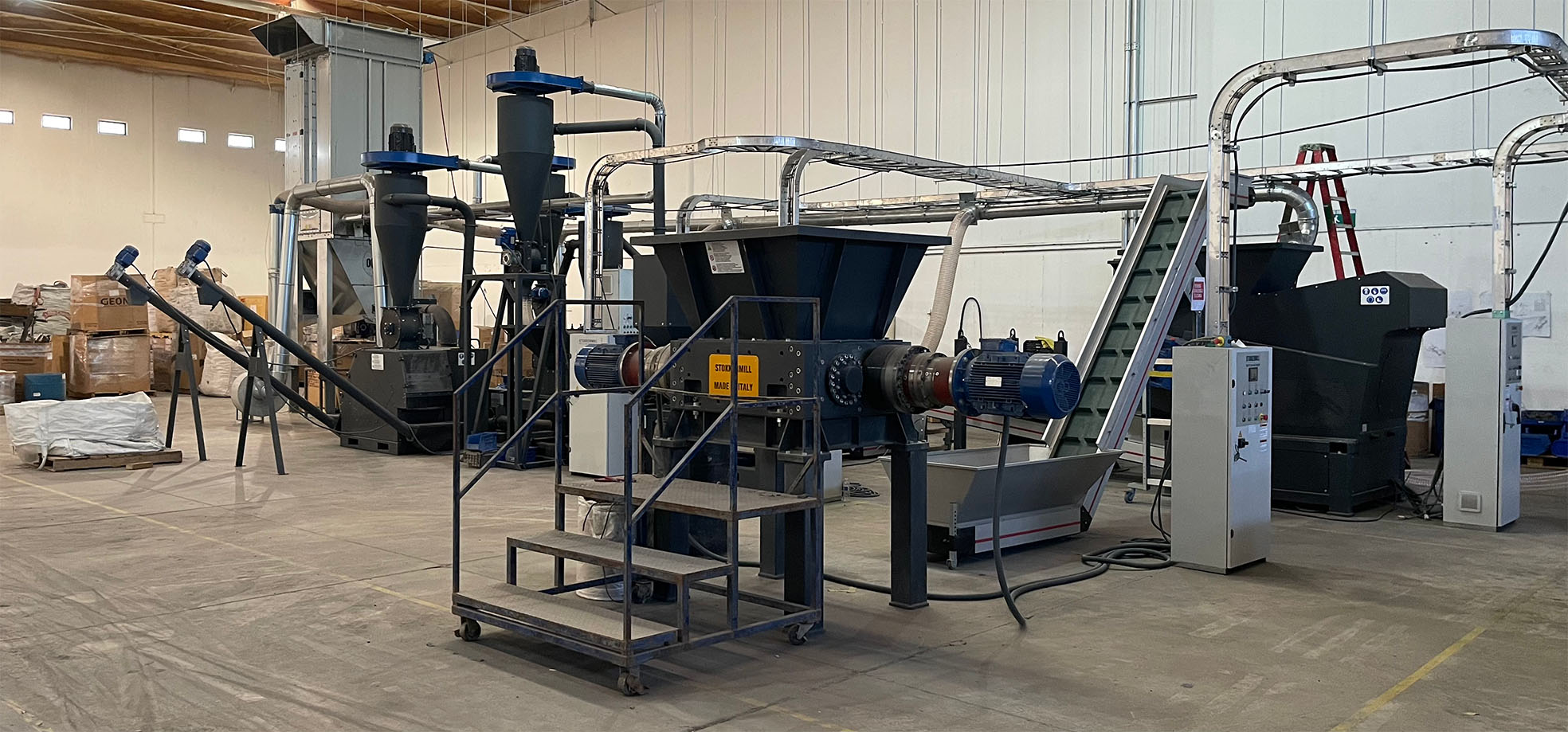

A pilot study typically runs on samples of a few panels under controlled conditions: intact modules, carefully selected, often from a single manufacturer and a single technology. That is the right method for validating a physical or chemical principle, and on those terms the studies deliver. The problem starts when you try to take that same technique and apply it to a real industrial facility. Whoever runs a recycling plant does not get to pick what comes through the door: the actual end-of-life stream includes broken panels, hail-damaged or freight-damaged modules, bifacial panels, amorphous thin-film, non-standard sizes, from different manufacturers and different technologies all mixed together in the same load. A process that in a lab handles one panel at a time, intact and correctly positioned, has to deal at industrial scale with a heterogeneous, unpredictable input, in volumes measured in thousands of tons per year, not dozens of samples. That is not a minor footnote. It is the difference between proving something can work and proving it works when it has to, on millions of panels, day in and day out, at a cost that actually makes sense.
There is a widespread assumption, rarely stated out loud but often present among industry watchers, self-appointed experts and even prospective buyers: that mechanical processing is a fallback option compared to more sophisticated technologies, chemical, thermal, laboratory-based, which get treated as inherently superior even when they have not yet proven they can hold up at industrial scale. That assumption falls apart when you look at one straightforward fact: solar panels themselves are manufactured through mechanical and industrial processes at massive scale. Reducing silica in a furnace, slicing ingots into wafers, assembling and laminating modules — the entire supply chain that produces billions of panels every year is built on scalable mechanical and thermal technologies, not on lab refinements. Not because more sophisticated scientific alternatives do not exist in theory, but because mechanical processing is, right now, the only economically viable route at industrial volumes. Holding recycling to a different standard than the one used to manufacture the product in the first place is not a technically grounded position. It is a distortion of expectations. You see a symptom of this distortion regularly in the promotional demos put out by certain recycling technology companies: anthropomorphic robotic arms handling one panel at a time with almost choreographed movements, built to impress on camera rather than to inform. Those are effective clips on social media, but they say very little about what actually matters: how many panels does that system process per hour, at what energy cost, and on what real-world input. A facility that needs to process thousands of tons a year is not judged by how good a mechanical gesture looks on video. It is judged by the numbers it sustains at full operation.
In the materials and industrial recycling space, the road from a scientific publication to a genuinely operational facility at commercial scale runs through a long sequence of stages: lab validation, scale-up to a pilot plant, process parameter optimization across growing volumes, industrial engineering, investment in a first demonstration facility, and finally commercial replication. It is not a straight line, and across many industrial sectors it typically takes several years, sometimes well over a decade, even when the lab results are rock solid. Not every promising technology makes it all the way through. Some stall at pilot stage for economic reasons, because the cost of the industrial plant does not justify the value of the recovered material. Others for scale reasons, because the process simply cannot sustain industrial volumes. Others still because they require too selective an input to be workable with a real end-of-life stream.
This time gap between scientific result and available industrial solution has a very concrete consequence: in the meantime, end-of-life panels keep stacking up. The U.S. regulatory environment is shifting fast. At the federal level, the EPA is developing guidance on solar panel waste classification, and several states including California, Washington, and New York have already moved toward or enacted extended producer responsibility frameworks specifically for photovoltaic modules. Meanwhile, the Inflation Reduction Act has accelerated domestic solar deployment at a scale that will produce a proportionally larger end-of-life wave sooner than many operators are planning for. But policy does not build the industrial infrastructure needed to meet its own requirements. If the most promising recycling technologies stay confined to pilot scale while end-of-life volumes grow according to projections the industry already has in hand, the real risk is a widening gap between what regulations require and what the industry can actually process, with direct consequences for landfill pressure, compliance costs, and who ends up bearing the burden of that shortfall. That risk rarely shows up in scientific papers, for the simple reason that it is outside their scope. But it is the question that anyone managing a plant, investing in a recycling line, or writing policy should be asking with the same rigor applied to measuring the purity of a lab sample. As manufacturers of industrial recycling technology, we follow every scientific development in this space with genuine interest, including the ones that are not yet ready for industrial scale. But we keep coming back to the same position: the right question to ask about any new study is not just what result it got in the lab. It is how much time, what investment, and what adaptation would it take for that result to hold up in a plant processing real panels, heterogeneous, unselected, every single day. If you are doing research in this space and want to compare notes with someone operating industrial recycling plants on the ground every day, we are open to that conversation.
20-07-2026