










Separating metals from plastics is a key step in recycling processes, especially when the incoming material consists of mixed fractions that are difficult to process with conventional systems.
To evaluate the real separation potential, Stokkermill ran a series of tests with its own laboratory electrostatic separator on PVC flakes contaminated with aluminum.
The test demonstrated the ability of the electrostatic process to concentrate the aluminum in a conductive fraction, separating it from the main PVC fraction. The tests were run at an operating voltage of 30 kV on two material samples with different particle sizes.
1. How does an electrostatic separator work?
An electrostatic separator leverages the different electrical properties of materials to separate conductive particles from non-conductive ones.
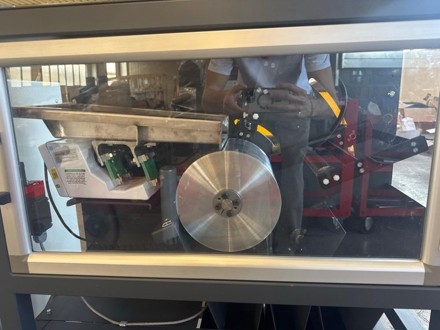
In the machine used for the test, the material is fed onto a grounded rotating stainless steel roll and passes through the electric field generated by the high-voltage electrode.
Aluminum, being a conductive material, quickly transfers its charge to the roll and is thrown forward by centrifugal force. PVC, on the other hand, is an insulating material: it holds its charge, stays pinned to the surface of the drum, and is discharged downward into its own collection fraction.
The system also includes a middlings fraction, intended for particles that show intermediate behavior during separation.
2. Electrostatic separation of aluminum and PVC
The test was run on PVC flakes contaminated with aluminum, containing fine metal particles and plastic fragments. Two samples were analyzed:
- one sample with an estimated particle size of approximately 2–6 mm (0.08–0.24 in);
- a second sample with a stated particle size of 1–3 mm (0.04–0.12 in).
In both cases, the contaminant consisted of aluminum flakes and thin aluminum foil.


The laboratory electrostatic separator splits the material into three distinct fractions:
- Conductive fraction – aluminum
- Middlings fraction – middlings
- Non-conductive fraction – PVC
This configuration makes it possible to evaluate not only how effectively the metal is removed, but also how the plastic fraction behaves during the process.

3. Test results: aluminum concentrated in the conductive fraction
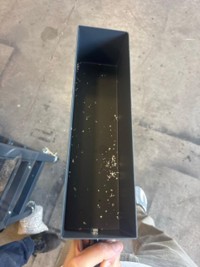
In the first sample, the conductive fraction consisted of a very small amount of material, made up mainly of thin flakes of bright aluminum with minimal plastic content. Metal separation proved effective.
The second sample also produced a small conductive fraction made up of aluminum flakes and thin foil. In this case, a few light-colored fragments were observed, attributable either to carried-over PVC or to painted aluminum or aluminum laminated with plastic.

4. PVC separated from aluminum
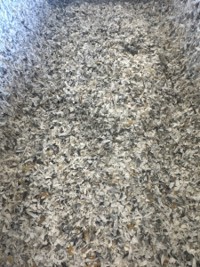
In both samples, the non-conductive fraction was the main fraction. In the first sample it consisted mostly of fine, thin and curled PVC flakes; in the second, thin white and gray flakes were predominant.
In both cases, no aluminum was detected in the PVC fraction during visual inspection.
The result confirms the value of electrostatic separation for processing plastics contaminated with conductive metals, where the difference in the electrical properties of the materials can be leveraged for targeted separation.

5. The middlings fraction: a parameter to optimize
In addition to the aluminum and PVC fractions, the process produces a middlings fraction.
In the first sample, this fraction was visually estimated at around 25–35% of the total material and consisted mainly of PVC with thicker, more compact flakes. In the second sample, the middlings fraction was also made up predominantly of thicker, stiffer flakes, with a slightly lower volume than in the first.
The test therefore highlights an important factor for process development: the yield of the PVC fraction can be optimized by adjusting the separation parameters and the material preparation. Based on the test observations, the behavior of the middlings particles appears to be driven more by the thickness and shape of the flakes than by the presence of contamination.
6. Stokkermill laboratory electrostatic separator
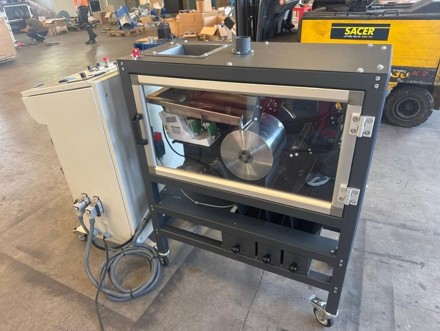
The separator used for the tests is a laboratory electrostatic drum machine equipped with:
- feed hopper;
- stainless steel vibratory feeder;
- electromagnetic vibrator with adjustable feed rate;
- variable-speed stainless steel roll;
- electrostatic generator adjustable up to 35 kV;
- adjustable-position electrode;
- material preheating system;
- adjustable splitters;
- three collection bins for the conductive, middlings and non-conductive fractions.
During the tests described, both samples were processed at an operating voltage of 30 kV.

7. Why use a laboratory electrostatic separator?
Lab testing makes it possible to evaluate how a material behaves up front, before designing or sizing an industrial plant. For aluminum-PVC separation, the test showed:
- effective concentration of the aluminum in the conductive fraction;
- a small, visually clean conductive fraction;
- a main PVC fraction with no aluminum detectable during visual inspection;
- consistent behavior across the two samples analyzed;
- the ability to adjust process parameters to optimize PVC yield.
The test concludes that electrostatic separation at 30 kV proved effective at removing aluminum from the PVC flakes in both samples analyzed.
The evaluations reported are based on a laboratory test and on visual inspection of the output fractions. Results depend on the characteristics of the material processed and do not in themselves constitute a guarantee of performance at industrial scale.
8. Electrostatic separation testing on real-world materials
The Stokkermill lab can run separation tests on real-world samples to verify material behavior and identify the best process parameters.
In PVC and aluminum separation applications, characterization of the incoming material (particle size, shape, thickness and composition) is essential for predicting the behavior of the different fractions.
Stokkermill develops solutions for the separation and recovery of materials in the recycling industry, with electrostatic technologies dedicated to sorting conductive and non-conductive materials.
10/01/2026