


We develop the best technologies for recycling materials to find innovative solutions for the energy and ecological transition
STOKKERMILL | SELTEK SRL © 2023 | P. Iva. IT02360630301 | Privacy | Terms










Over the past two years, the European Union has built, step by step, a regulatory framework around a concept that until recently was mainly discussed in specialized technical reports: critical raw materials.
In U.S. industry and policy, the term critical minerals is more commonly used. The EU framework refers to critical raw materials, but the underlying concern is the same: ensuring reliable access to materials that are essential to energy, manufacturing, and digital infrastructure.
Copper, silicon metal used in solar manufacturing, rare earth elements, and lithium — together with other strategically and economically important materials such as silver — are essential to Europe’s energy and digital transition. Yet the EU remains heavily dependent on imports from outside Europe, often concentrated in a single supplier country.
The European Commission outlines the scale of the challenge in the Critical Raw Materials Act: European demand for rare earth elements could increase sixfold by 2030, while demand for lithium could increase twelvefold.
Against this backdrop, expanding recycling capacity is no longer just an environmental objective. It has become a matter of supply-chain security, industrial resilience, and strategic autonomy.
The first regulatory pillar is Regulation (EU) 2024/1252, known as the Critical Raw Materials Act, which took effect on May 23, 2024.
The regulation establishes clear benchmarks for 2030:
For recycling companies, however, the most important figure is not only the 25% recycling benchmark. For the first time, the regulation begins to address not just how much material is recycled, but what the recycling process actually produces.
It introduces the first binding information and labeling requirements related to the recyclability and recycled content of permanent magnets. The initial scope is specific, but the underlying principle is clear and could gradually be extended to other materials and product categories.
The regulation also supports the broader transition toward end-of-waste status: the point at which a processed waste stream legally stops being waste and becomes a marketable secondary commodity with its own legal and commercial status.
The second regulatory pillar is expected in 2026. The European Commission closed its public consultation on the Circular Economy Act in November 2025, and adoption of the initiative is scheduled for this year.
Its stated objective is clear: to establish a genuine European Single Market for secondary raw materials, increase the supply of high-quality recycled materials, and, above all, stimulate demand for those materials.
This represents an important shift in perspective. Until now, European policy has focused primarily on companies that collect and recycle waste. Going forward, it will also focus more closely on companies that purchase and use recovered materials — and on the evidence required to demonstrate that these materials provide a reliable alternative to virgin feedstock.
The Circular Economy Act is also expected to include a revision of the EU WEEE Directive governing waste electrical and electronic equipment. In the United States, these material streams are more commonly described as e-waste or e-scrap.
The European Commission published its evaluation of the existing WEEE Directive in July 2025, identifying the need to improve collection, processing, critical-material recovery, and market incentives.
This revision directly affects companies processing end-of-life solar panels, printed circuit boards, electrical wire and cable, and other electronic scrap streams.
From an operational standpoint, the direction is clear: recycling companies will increasingly be expected to declare — and substantiate — what their systems actually produce, not simply what they might produce under ideal test conditions.
This is the same principle behind some of the most widely read articles published on our blog in recent months.
When we explained that solar panel recycling does not directly produce solar-grade silicon — because that purity level requires processing in a furnace at approximately 2,000°C, followed by purification in a Siemens reactor at approximately 1,100°C — we were already applying this approach.
The actual output of the mechanical recycling process is a silicon-rich concentrate. In the batches we analyzed using X-ray fluorescence spectroscopy, silver concentrations ranged from 2,500 to 4,800 ppm.
By reporting the actual composition of the recovered material instead of presenting only the most commercially favorable interpretation, we were already applying the principle that the European regulatory framework is now beginning to formalize.
It is important to be clear on one point: these figures come from our analyses of specific batches. They are not universal reference values for the entire industry.
The concentration of silver and other precious metals can vary significantly depending on the module manufacturer, production technology, and year of manufacture. The amount that can actually be recovered from a particular batch may therefore be unexpectedly high or low, even for operators with many years of industry experience.
The same caution applies to copper granules recovered from electrical wire and cable. There can be a substantial difference between a recovery rate reported under laboratory conditions and the real-world result measured after dozens of operating hours with mixed, heterogeneous feedstock.
This is precisely the type of data that will become increasingly important. Existing technical frameworks — including the CENELEC EN 50625 series for WEEE and e-scrap processing — and future measures under the Circular Economy Act will make these results more central, verifiable, and comparable among equipment and technology suppliers.
One interpretation of this regulatory direction stands out to us more than any other.
For years, we have chosen to report real-world operating results instead of catalog figures. We openly explain the physical limits of what a recycling system can achieve and provide specific ppm values and percentages rather than relying on general claims about “high quality.”
We initially made this choice as part of our commercial positioning. We call it industrial honesty.
With the Critical Raw Materials Act already in effect and the Circular Economy Act approaching, this same transparency is gradually shifting from an optional competitive advantage to a condition for participating in the European secondary-materials market.
Companies that have already built their processes and communications around verifiable data are starting from a stronger position.
Companies whose market positioning relies primarily on sales claims will eventually have to close the gap between what they promise and what a third-party certifier, industrial buyer, or regulatory authority expects to verify.
For U.S. recyclers and equipment suppliers, this is not simply a distant European issue. Companies serving multinational customers or selling recovered commodities into international supply chains will increasingly be asked to provide the same verifiable output data, particularly when those materials or products enter the European market.
We remain convinced that the right question in response to every new recycling regulation is not only what it requires on paper. It is also what it demands in practice from a system processing real, mixed feedstock every day of the year.
If you work in solar panel, wire and cable, or e-scrap recycling and would like to discuss what these developments mean in real-world operations, we are available for a technical conversation.
What is the Critical Raw Materials Act?
The Critical Raw Materials Act is Regulation (EU) 2024/1252, in effect since May 23, 2024. It establishes 2030 benchmarks for the extraction, processing, and recycling of strategic raw materials, as well as for the diversification of imports. It also introduces the first binding information requirements related to recyclability and recycled content.
What is the Circular Economy Act, and when will it take effect?
The Circular Economy Act is a forthcoming EU legislative initiative scheduled for adoption in 2026. It is intended to establish a European Single Market for secondary raw materials, increase the supply of high-quality recycled materials, and stimulate demand. Its precise effective date will depend on the final legal structure and completion of the European legislative process. The initiative is also expected to include a revision of the EU WEEE Directive.
What are critical secondary materials?
They are materials classified as critical under the EU framework — including copper, silicon metal, rare earth elements, and lithium — that are recovered through recycling instead of being extracted from primary sources. Recycling can also recover other strategically and economically important materials, including silver.
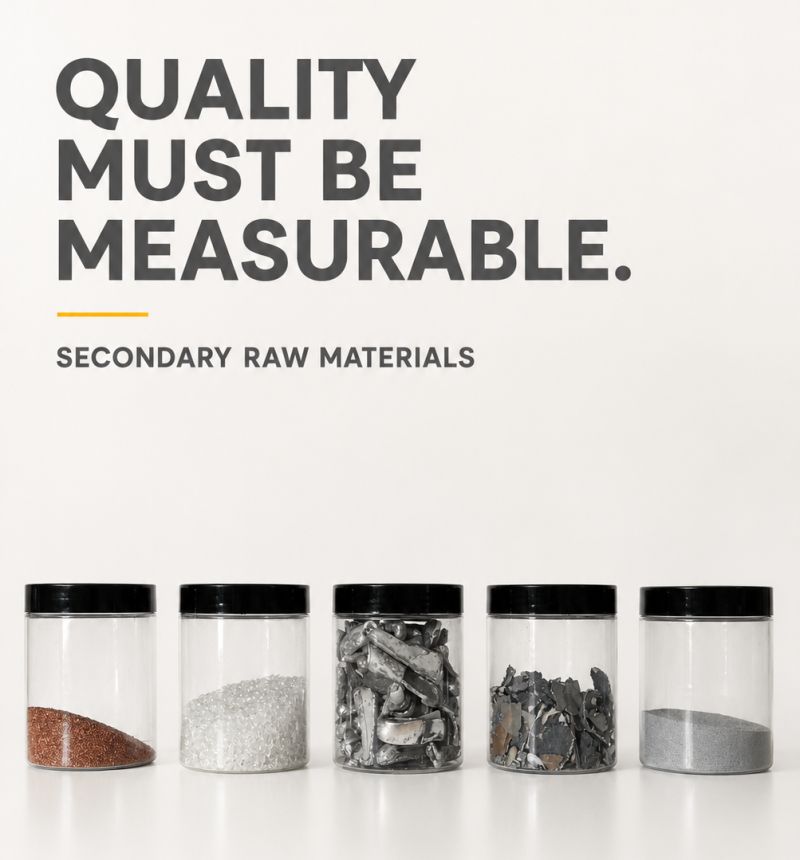
Why is recycled-material quality becoming a regulatory issue rather than only an industrial concern?
The European Union aims to establish a functioning market for recycled materials. Without measurable and verifiable quality standards, industrial buyers have little reason to select a secondary material instead of virgin feedstock. This approach is also relevant to U.S. companies supplying global manufacturing and recycling markets.
Does solar panel recycling produce silicon that can be reused in new modules?
Not directly. Mechanical recycling does not produce solar-grade silicon that is ready for use in new photovoltaic cells. Achieving the required purity involves additional high-temperature processing and chemical refining, including treatment at approximately 2,000°C and purification in a Siemens reactor at approximately 1,100°C.
The direct output of recycling is a silicon-rich concentrate. Its current economic value is largely related to the silver it contains, which can be recovered through hydrometallurgical processes.
07-31-2026