We develop the best technologies for recycling materials to find innovative solutions for the energy and ecological transition
STOKKERMILL | SELTEK SRL © 2023 | P. Iva. IT02360630301 | Privacy | Terms










In the precious metals industry, gold and silver are generally associated with their high economic value and the downstream smelting and refining stages. Before the material reaches the furnace, however, there is another equally important stage: material preparation.
Jewelry, chains, deformed parts, production scrap, and other gold- or silver-bearing materials can vary significantly in shape and size. For companies handling these materials, making them more compact, manageable, and suitable for the next stage can be an important part of the overall process.
In this context, volume reduction serves a specific purpose: not as a refining process, but as a mechanical preparation step before smelting.
The growing focus on recovering and maximizing the value of precious metals is leading companies to examine every stage before smelting more carefully.
For a gold-buying business, jewelry industry operator, precious metal scrap processor, or smelting facility, the incoming material can be extremely diverse:
Mechanical preparation makes it possible to address this stage without confusing it with the downstream operations of smelting, separation, or refining.
Reduce volume
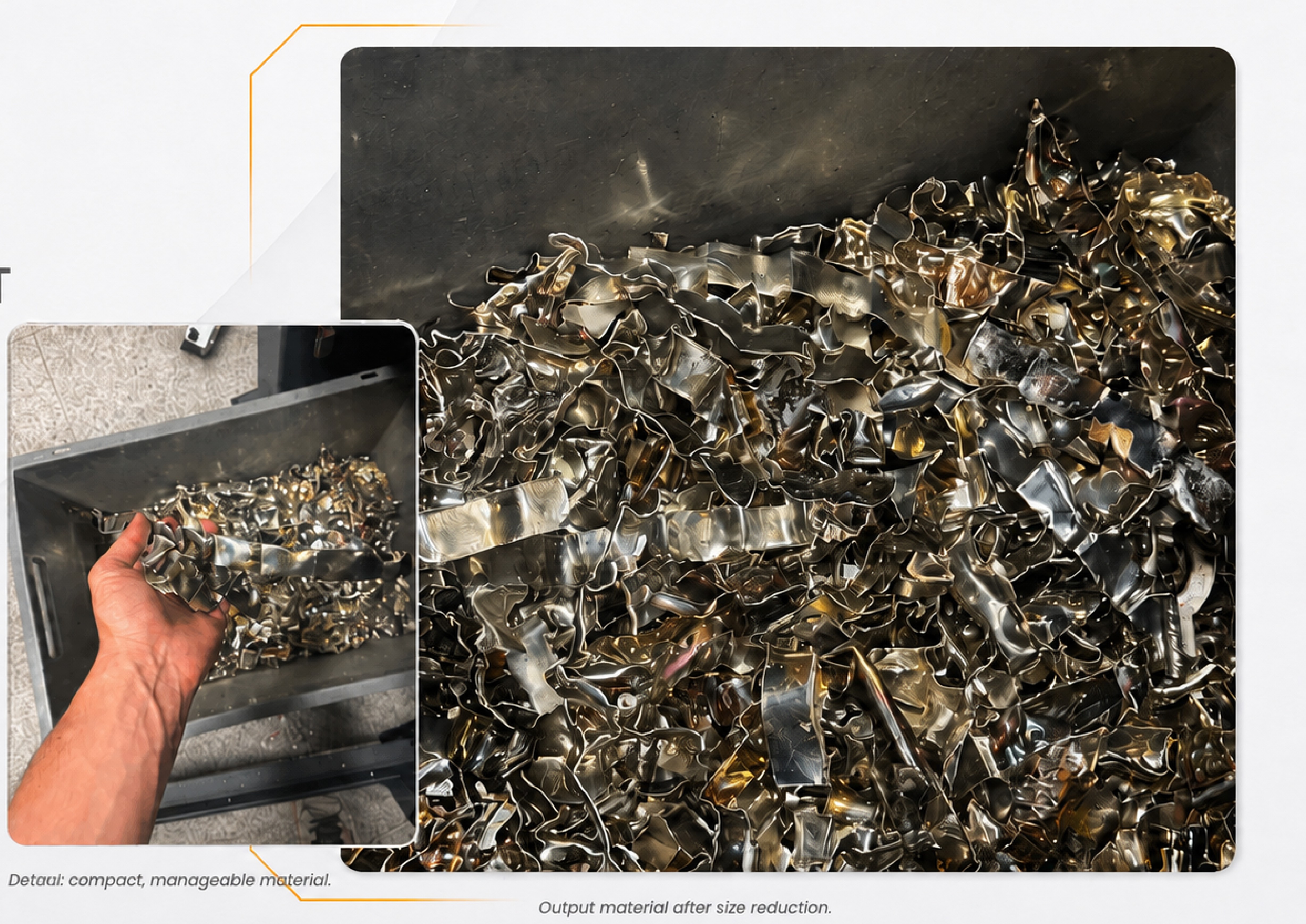
Bulky materials or objects with irregular geometries can occupy considerable space relative to their weight. Volume reduction produces a more compact material that is easier to handle.
Improve material handling
Mechanically prepared material can be transferred, stored, and fed into subsequent processing stages more easily.
Process irregular shapes
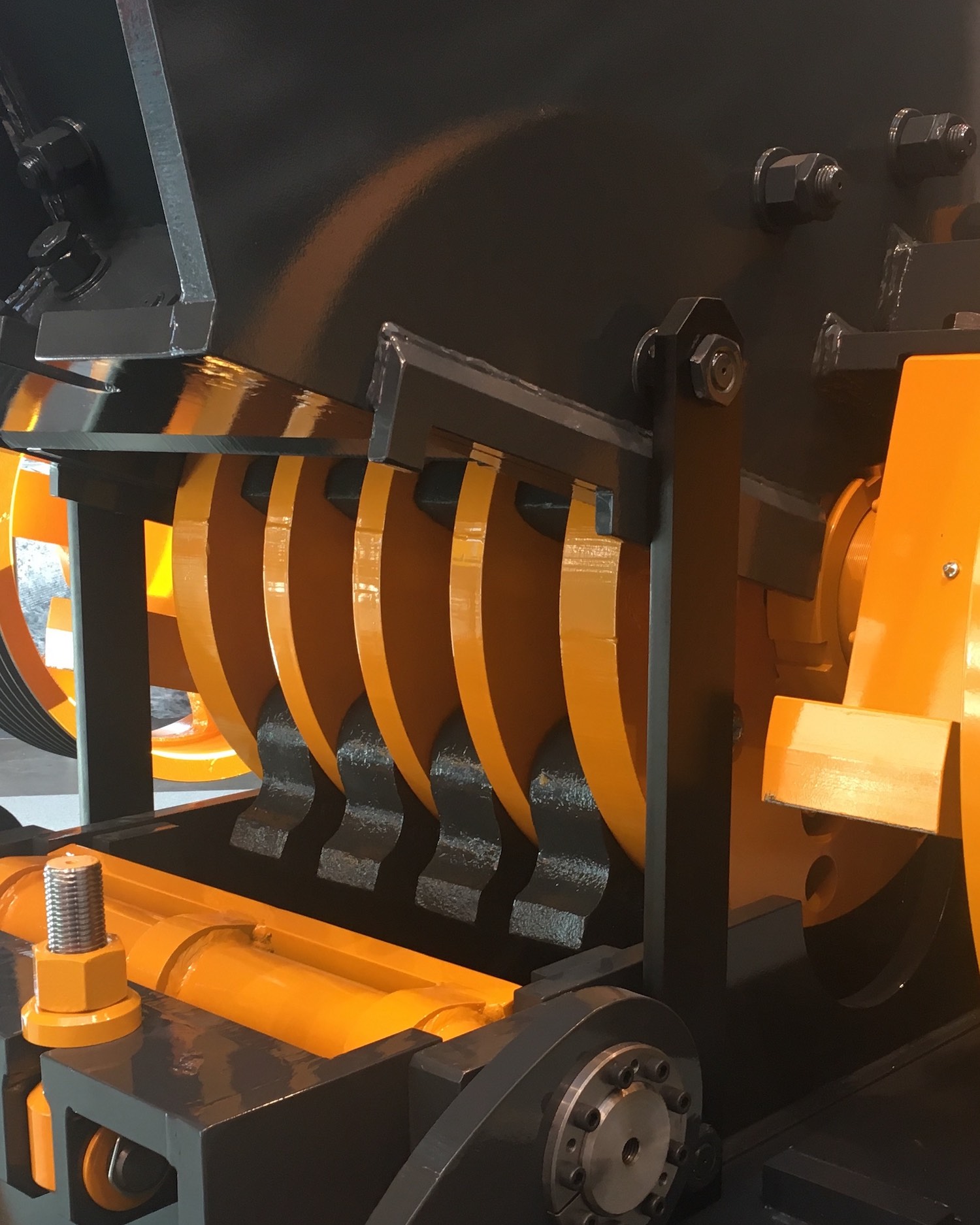
Chains, deformed parts, and other metal objects can be difficult to handle manually. Twin-shaft technology can grip the material and subject it to controlled mechanical size reduction.
Reduce reliance on manual operations
For companies processing significant quantities of precious metal materials, automating the preparation stage can make the workflow more structured and repeatable.
It is important to distinguish clearly between the different operations. Shredding does not determine the purity of gold or silver, nor does it replace smelting or refining.
The machine’s role is to physically prepare the material for the next stage. The process can be summarized as follows:
Incoming material → handling and sorting → volume reduction → preparation before smelting → smelting → refining
Gold-buying businesses are among the points where precious metal materials enter the chain that leads to their subsequent recovery and utilization. The collected material can be sent for smelting and then to additional recovery and refining processes.
In this context, material preparation can become a dedicated industrial processing stage. The objective is not simply to move metal scrap, but to organize the material flow through to the smelting stage.
For professional operators, this means that a dedicated mechanical stage can be integrated between incoming material handling and downstream processing.
Critical raw materials are currently at the center of European and industrial discussions and are often associated with precious metals. Precision is important, however: gold and silver are not currently classified as European Union critical raw materials under the list established by the Critical Raw Materials Act.
Nevertheless, supply security, circularity, and the use of secondary materials—the same principles shaping critical raw materials policies—are becoming increasingly important in the precious metals industry as well.
For this reason, gold and silver can be described as strategically important resources: high-value materials that require increasingly efficient handling and preparation processes.
Preparing material before smelting is therefore part of a broader development: improving the efficiency of the processing chain and maximizing the value of a resource that is already available.
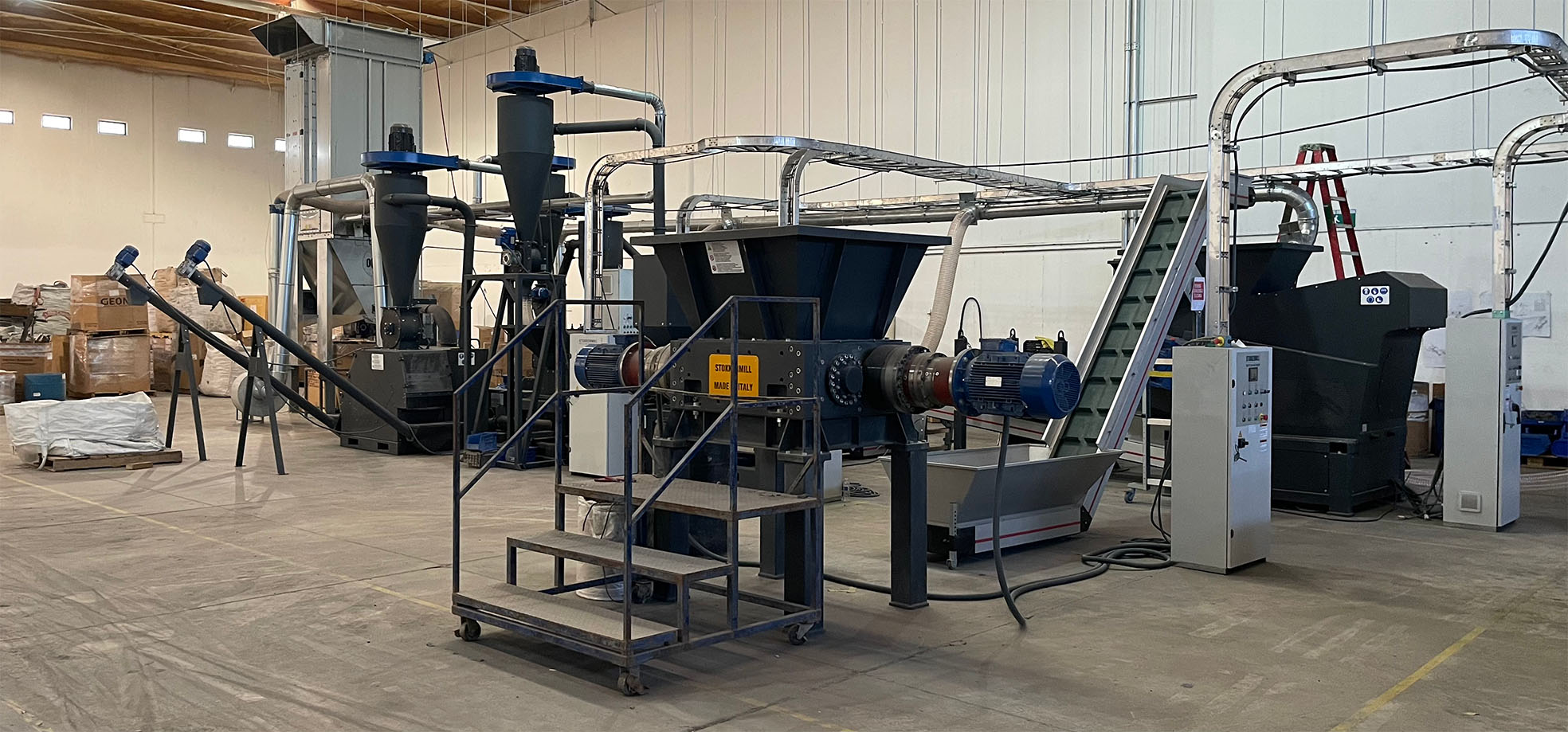
The Stokkermill D15 is a twin-shaft shredding solution that can be configured to prepare metal materials for subsequent smelting.
A D15M configuration was specifically proposed for reducing the volume of silver before the smelting stage. This configuration features special shortened blades designed to improve material grip during processing.
MOTOR POWER: 2 × 4 kW (2 × 5.4 hp) | SPEED: 10–15 rpm | WEIGHT: approximately 1,540 lb (700 kg)
This documented application confirms a clear principle: the D15 can be used as a preparation machine to reduce the volume of silver before the subsequent smelting stage.
In this application, the value of the D15 does not lie in refining the metal, but in physically preparing the material.
The machine operates before the smelting stage and can help transform bulky or irregular material into a form that is easier to manage during downstream processing.
This approach is relevant to several types of operations:
When discussing gold and silver, attention naturally tends to focus on smelting and refining. However, the quality and efficiency of the workflow also depend on what happens before the material reaches the furnace.
Pre-smelting preparation allows material to be processed in a more structured way, reduces its volume, and improves its handling characteristics.
For this reason, twin-shaft shredding should be considered not only a recycling technology, but also a technology for preparing precious metal materials.
The D15M configuration documented for silver is a practical application from the precious metals industry. Its purpose is simple and clearly defined from an industrial perspective: reduce the material’s volume and prepare it for the subsequent smelting stage.
For Stokkermill, the focus is not only on the machine itself, but also on how it is integrated into the overall process:
Prepare the material, reduce its volume, and feed it into the smelting stage.
The images show an actual example of the material after processing. The output material has smaller dimensions and a more manageable form than the bulky, irregular metal material originally fed into the machine.