


We develop the best technologies for recycling materials to find innovative solutions for the energy and ecological transition
STOKKERMILL | SELTEK SRL © 2023 | P. Iva. IT02360630301 | Privacy | Terms










A recycling plant should solve today’s problem without becoming tomorrow’s limitation.
When entering a new recycling market, the first question is often about capacity.
How many tons per hour?
This is an important question, but capacity is only part of the decision. The plant must process the volumes currently available while remaining suitable for the direction in which the business, material streams, and market may develop.
For Stokkermill, scalability starts with process and layout design. It means developing a recycling system around the current input material and production targets while considering how the plant could evolve if volumes increase, input composition changes, or new recovery opportunities emerge.
Processing capacity is one of the most visible parameters when comparing recycling plants. It affects machine selection, installed power, layout, auxiliary equipment, and the organization of the entire production process.
However, selecting the highest possible capacity from day one is not always the most appropriate investment strategy.
Material volumes may still be growing. Supply agreements may not yet guarantee a continuous flow of input material. Input composition can change, and new recovery targets may emerge as markets and downstream requirements evolve.
A business that starts with one material may later identify opportunities in complementary streams. At the same time, the quality expected from the recovered fractions may become more demanding.
For this reason, the correct question is not simply how many tons per hour the plant can process. It is also whether that capacity corresponds to the material that is actually available and whether the initial configuration can support the company’s future development.
An oversized plant can absorb capital before the material is actually available.
Higher processing capacity generally requires a larger investment, more space, greater installed power, and an input flow capable of keeping the system productive. If the available volumes are lower than expected, the customer may have invested in capacity that cannot yet be used efficiently.
A rigid plant creates a different risk. It may be suitable for the initial application but become inadequate as soon as the market changes.
Input materials are rarely completely consistent. Their dimensions, composition, contamination levels, and physical characteristics may vary. The commercial value of the recovered fractions can also change, creating new requirements for separation and refinement.
A recycling plant must therefore be evaluated not only for what it can process today, but also for its ability to remain useful as the operating environment evolves.
For us, scalability starts with process and layout design.
It does not begin by simply adding a larger machine at a later stage. It begins by understanding the customer’s material, the available volumes, the required output quality, and the point the business wants to reach.
The initial layout should consider the position of the main machines, material transfer systems, separation equipment, filtration units, storage areas, and possible future expansions. Available space, electrical infrastructure, maintenance access, and the movement of incoming materials and recovered outputs must also be evaluated.
Designing these elements correctly from the beginning can make future expansion more organized and reduce the need to modify the entire production area.
Scalability is therefore not only a question of machine capacity. It is a characteristic of the complete process.
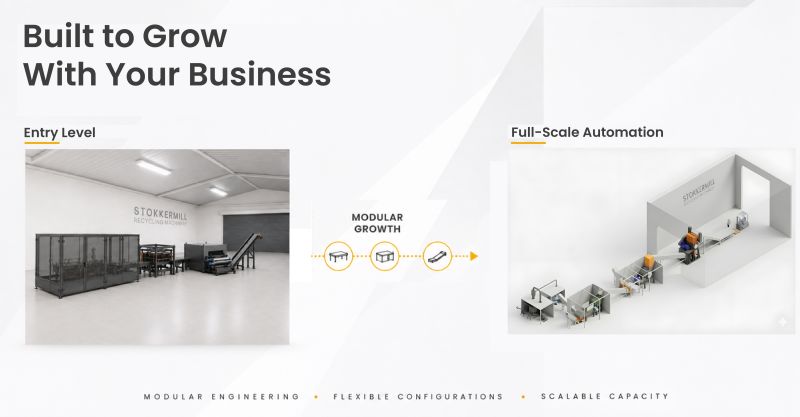
A customer can begin with a smaller, more accessible configuration and then, if needed, expand it progressively and increase productivity.
This approach can be particularly relevant when entering a new recycling market or when the quantity of available material is expected to grow gradually.
The initial plant can be designed to process current volumes without requiring an investment based exclusively on future expectations. As the business develops, selected sections of the process can be integrated, upgraded, or supported by additional equipment.
Depending on the application, growth may involve increasing feeding capacity, adding further size-reduction stages, introducing new separation technologies, or improving the refinement of specific output fractions.
The objective is not simply to make the plant larger. It is to expand the process where the actual material flow and recovery targets require it.
Flexibility can also mean designing selected configurations for more than one compatible application.
Some Stokkermill systems, for example, can be configured to process photovoltaic panels and e-waste, or different metal and composite fractions, using dedicated settings and auxiliary equipment.
This approach can help a recycling company evaluate complementary material streams without necessarily creating a completely separate process for every application.
However, flexibility must always be technically defined. Different materials behave differently during feeding, size reduction, separation, and refinement. Their dimensions, composition, abrasiveness, moisture content, and contamination levels can affect the performance of the complete system.
A flexible recycling plant must therefore be based on verified compatibility between applications, not on the assumption that every material can be processed in the same way.
Dual-use does not mean feeding any material into the same machine.
It requires input analysis, defined operating parameters, proper preparation, and clear quality targets for each output fraction.
A configuration developed for more than one application may require different feeding procedures, interchangeable components, dedicated screens, specific machine settings, or additional separation equipment. The operating sequence may also change according to the material being processed.
Before defining a dual-use configuration, it is necessary to understand what enters the plant and what must come out of the process.
This includes analyzing the dimensions and composition of the input, identifying incompatible materials, defining the required degree of size reduction, and establishing the acceptable level of contamination in each recovered fraction.
Flexibility is effective only when each application has a clearly defined process.
That is why we do not start from a catalog model.
We start from the material, the available volumes, the customer’s investment plan, and the point the business wants to reach.
Two companies operating in the same recycling sector may require very different plants. One may have a stable and homogeneous input stream, while another processes smaller quantities of more variable material. One may prioritize production capacity, while another may focus on obtaining more refined output fractions.
The available building, electrical service, staffing, operating workflow, and downstream markets for the recovered materials can also influence the final configuration.
Machine selection comes after this analysis. The objective is to create a coordinated process in which feeding, size reduction, transport, separation, and refinement work together according to the characteristics of the material.
A scalable plant requires a realistic understanding of both the present situation and the expected development of the business.
The first stage is to define the current input material and the quantities that are genuinely available. The next step is to establish the required output fractions and the quality expected by downstream processors, buyers, or end users.
The customer’s investment plan must then be considered. This includes not only the initial budget, but also the possibility of expanding the system if additional volumes, materials, or recovery targets become commercially relevant.
The layout can consequently be developed around an initial configuration while preserving the space, connections, and material flow required for selected future additions.
This does not mean predicting every possible market change. It means avoiding design choices that would unnecessarily prevent the plant from evolving.
The initial plant should remain useful as the customer grows.
A smaller starting configuration should not be considered a temporary solution that will inevitably become obsolete. When correctly designed, it can form the foundation of a more productive and complete recycling process.
Existing equipment may continue to perform its original function while new sections are added around it. In this way, expansion can preserve part of the initial investment and follow the actual development of the customer’s business.
The timing and form of each expansion must always depend on the material, operating experience, and commercial objectives. Growth should respond to a demonstrated need rather than to capacity alone.
And when growth comes, the customer should not be forced to start again from zero.
A recycling investment must balance present requirements with future possibilities.
Maximum capacity from day one may be appropriate when input volumes are already secured and the production target is clearly defined. Progressive growth may be more suitable when the market, material availability, or application is still developing.
There is no universal configuration that is right for every recycling company.
The role of process design is to connect the material available today with the production level the customer may need tomorrow. Capacity, scalability, and flexibility must therefore be evaluated together.
For Stokkermill, this means developing recycling plants around the input material, the required outputs, and a realistic investment plan.
The objective is clear: solve today’s processing requirements without turning the initial plant into tomorrow’s limitation.
When planning an investment in recycling, what do you prioritize: maximum capacity from day one, or the ability to grow progressively?